Showing posts with label james stewart. Show all posts

4.18.2012

50/50 Review #14: The Man Who Shot Liberty Valance.

Despite the fact I live in Texas, I'm not a big fan of westerns. That doesn't mean I can't enjoy one every now and then, but in general, they aren't my cup of tea. So when I saw I had a western on this list, I was slightly wary. The story follows a lawyer and/or senator named Ransom Stoddard (Jimmy Stewart) who comes back to the town of Shinbone for the funeral of an old friend, Tom Doniphon (John Wayne). The rest of the film is told in flashback as Ransom relays his story of how he came to shoot the evil outlaw, Liberty Valance (Lee Marvin). He also gains the affection of a woman named Hallie (Vera Miles), who Doniphon also has the sweets for.

While I'm not a fan of westerns, I am a fan of Jimmy Stewart. I've basically enjoyed everything I've ever seen him in; even if I don't like the movie itself, I've always liked him in it. This is no exception... except I kinda enjoyed the movie this time, too. I have seen a number of Stewart's films; however, this would be my first John Wayne film (I know... gasp!). And he gave me pretty much everything I expected. He had a strong presence, a fun way of talking, and said "pilgrim" about a hundred times. And that was good enough for me. So the two of them were the strongest part of the film for me. The relationship between the two of them was great.

There were only two real downsides to me, though. The first being something rather major--Liberty Valance wasn't a menacing villain. Lee Marvin wasn't bad, per se, but the character was supposed to be this outlaw of epic and diabolical proportions. I expected him to show me why he struck fear into the hearts of all these people. Instead, he was more pathetic to me. He was only kind of scary when he had that whip thing, but he only used that maybe twice in the whole film. And when the title itself centers around his eventual death, I wanted him a little more terrifying. Not to mention the implications of having one of his no-name henchman be Lee Van Cleef, the freakin' BAD in Good/Bad/Ugly (OK, I know this came out before that, but still)! Because of all this, the big David and Goliath showdown didn't feel as hefty and suspenseful as it could have been. The second downside involved a couple of the subplots. First, there's a subplot where Stoddard teaches people to read that goes absolutely nowhere. Second, the political subplot that goes throughout the film and then takes up most of the third act is just... dull. I really didn't care at all about any of that.

Otherwise, the drama and the comedy was good (haven't really touched on the comedy, but there are some pretty funny moments in the film). Tom Doniphon was a really good character with a lot of internal conflict, particularly pertaining to the kind of "love triangle" with Hallie. So I did really like John Wayne, and I still really liked Jimmy Stewart. The turmoil he faces due to the truth of his story is well written and performed. If you're a fan of westerns, I can't imagine that, well, you haven't already seen this. But if you haven't, I have no doubt you'd enjoy it. If you're not a fan of westerns, I say it's worth watching for the two leads and their character archs alone.


I Am McLovin!

7.20.2011

60/60 Review #37: Rear Window.

Let's get this out of the way at the start: Yes, I knew the film Disturbia was a remake of this film... I just didn't know how much. I thought it just took the basic concept, but no. There is a ton of stuff that film takes from this. But did basically knowing the movie beforehand through its remake affect the viewing of this film?

For those that don't know, the film tells the story of L.B. Jeffries (James Stewart), a photographer stuck in a wheelchair due to a broken leg. He has one week left in the cast and contends with a spunky nurse named Stella (Thelma Ritter) and his nearly perfect model girlfriend, Lisa (Grace Kelly). To pass the time, he spies on all his neighbors. One day, however, he starts believing that one of the men, a man named Lars Thorwald (Raymond Burr) might have murdered his own wife and is trying to get rid of the evidence. Even bringing in an old detective friend, Thomas Doyle (Wendell Corey), he has a hard time convincing anyone that his suspicions are true.

This is probably one of the most perfectly paced films I've ever seen. The first 30 minutes or so set up all the characters, including the ones he spies on. It sets up the relationships and how everything will inevitably evolve throughout the rest of the film. After this, once the murder aspect is tossed in, it slowly builds its suspense. It takes us on a "is he or isn't he?" trail... though I figured I knew the ending based on Disturbia. Still, it didn't really deter me from enjoying the film or feeling the suspense.

So far in each Hitchcock film I've watched, it seems there's at least one character that bugs me. Here, that's not the case. Every character has a purpose, and almost every relationship goes somewhere. (The gorgeous) Grace Kelly begins as this perfectly little model who is kind of in her own world of fashion and glam. Because of this, Jeffries is conflicted on their relationship as she's not really adventurous or even close to the type of person he is. Of course, this changes as the film goes on. And then James Stewart (yet again) is here, again in a type of detective role. It's no real shock that I enjoyed him--but I will also add that this is definitely my favorite role/movie of his that I've seen thus far. My favorite character, though, had to be the nurse, Stella. She was really funny, and her acting felt much more modern than of those around her. And I haven't even mentioned all the neighbors who might not even speak, but still get their own story arcs.

The writing is very tight and clever. There's a lot of good dialogue, the cleverest usually coming between Jeffries and Doyle or Stella. But the characters never say more than they need to. This does leave a handful of things up to the imagination, though, due to some unanswered questions (a handful of "why"s, at least for Thorwald).

The directing and camera work was top notch. As we know, I love a good film in a tight space. The whole film takes place in that apartment--or at least through the perspective of the apartment--with a couple minor exceptions. And there were also a handful of great single takes panning around the apartment buildings (which was really, at that time, the biggest indoor set for the studio). Hitchcock really was great at manipulation. Even the music (with the exception of the very beginning) was done completely within the realm of the film--no external movie music added--adding a deeper sense that you're trapped in this apartment complex.

Overall thoughts? If you've seen and like Disturbia (as I will admit, I do), and would like to see the less modernized original (and not to mention where the accused is much less obviously evil), definitely check it out. Actually, I'd say check it out, anyway. It's quite excellent. Anyway, there are only a couple more Hitchcock films left for me to review this month, but as of now, this one just slipped into first place as my favorite.

Rating System.
Royale With Cheese

7.13.2011

60/60 Review #36: Vertigo.

At the time of its release in 1958, Vertigo was a public and critical failure--only later to be considered, along with Psycho, one of Hitchcock's best films... possibly even his masterpiece (and on top of that, considered one of the greatest films ever made). Like with Rope 10 years prior, one of its biggest complaints was that some (including Hitchcock) felt James Stewart was miscast. In fact, despite Stewart being one of his biggest collaborators, Hitchcock never worked with him again after this film.

The film focuses on a San Francisco detective, John "Scottie" Ferguson (James Stewart). After a bad case that ended in another cop's death and that left Scottie hanging from the rafters, Scottie gained a bad fear of heights and vertigo. He quits his job because of it, but is soon hired by an old college buddy, Gavin Elster (Tom Helmore), to follow his wife Madeleine (Kim Novak) because she keeps wandering off, and he thinks she's been possessed by the spirit of her great grandmother. But in the process, he becomes too obsessed with her, and his sanity starts slipping the further into the case he gets.

Most people's biggest complaint seems to be the complicated plot, but that didn't really bother me (at least not directly). In fact, there were parts that reminded me somewhat of Kiss Kiss Bang Bang (very loosely, mind you)--complicated, but with a damn good twist. Speaking of comparisons, very early on in the film I was reminded of Les Diabolique, which you might remember I reviewed back in May. Coincidentally, I discovered that this is based on a book that the authors wrote specifically for Hitchcock after he failed to get his hands on the adaptation of their other book... which, you guessed it, was adapted into Les Diabolique.

No, my biggest issue stemmed from the fact this movie never seems to end. At about the 50-minute mark, I felt I was about to reach the climax of the film as it seemed it had been going on so long. This movie is 128 minutes. It's a very long, drawn-out, slow film... and there actually is a huge twist about the 90 minute mark that would normally go at the end of the film. But there's still another 40 minutes after that. Long story short, it definitely could have been trimmed down.

There also seems to be a strange issue with time. By that I mean that it's very hard to discern just how much time has gone by at any given point. I figure for most of the first hour, only 1-3 days tops has gone by (and in that time, he falls madly and dangerously in love with a woman he barely knows... which I'll get to shortly). Then there's a part I really can't get in to without spoiling anything, but there's apparently this large time jump. I had to look it up to find out it was a whole year, as it's not really clear at all within the film how much time had passed.

I've said it in my other two reviews with the man during this project, but I really like James Stewart. His acting was superb in this film. That being said, his character bugged the heck out of me at times. He starts out likable enough, but he just goes nuts, falls for this woman he doesn't even know (a woman who is supposed to be married, at that), and--later--gets obsessive to the point of crazy creepy freak, who I would have called the cops on more than once during this movie. That aside, everyone else's acting is decent, though it does eventually delve into that cheesy, over-the-top, "old-timey" acting that I don't care for (except, of course, in Gone With The Wind).

All of that being said, this is definitely one I need to see again. I mean, seriously, even the IMDb FAQ on the film says first-time watchers tend not to care for the film, as they focus too much on the intricacies of the plot, some implausible things, and the fact that the movie never seems to end (partially thanks to the twist). I can agree with all of that, frankly, but it is one I'd be willing to give a second chance now that I know the story and wouldn't be nearly as focused one what the heck is going on.

Unfortunately, however, this review is for my initial viewing. And upon said viewing, I thought the film was too long, I didn't care for the main character (despite his generally great acting), and I felt the story and pacing didn't match up well enough (a different issue to me than it being too long, but somewhat related... if that makes sense). The movie is saved by innovative filmmaking and a fantastic twist, though. There's just too much other stuff that, at least at first glance, makes the film appear rather flawed.


Stop Saying OK! OK.

(P.S. I was originally going with a higher scoring. But as I let my thoughts settle and the film sink in, most of the initial positive emotions evened out and I felt this was more appropriate. And I prepare to be flogged for it.)

7.06.2011

60/60 Review #35: Rope.

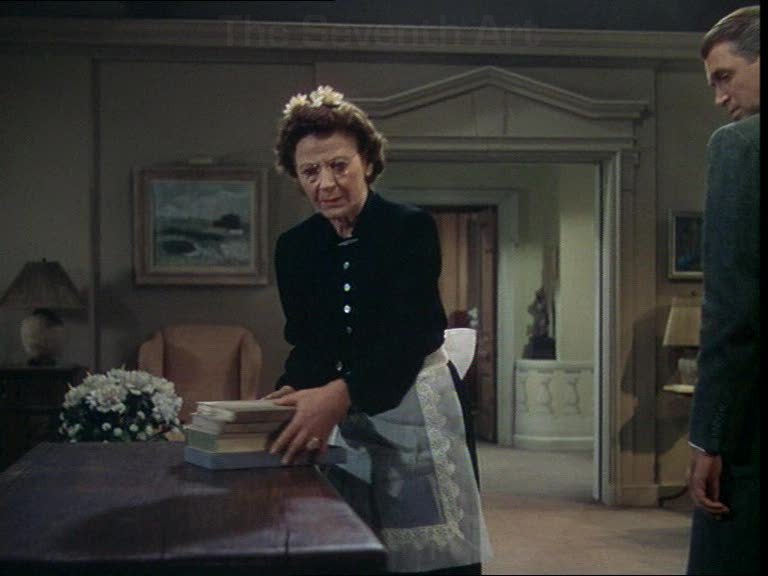
Let us begin now with my very first Hitchcock film. Doing a bit of research, I found the behind-the-scenes stuff was almost as interesting as the film itself. But let's start with the film first. Rope tells the story of two young men, Brandon (John Dall) and Philip (Farley Granger), who have just finished murdering David (Dick Hogan) by strangling him with a bit of rope... just because they wanted to see if they could get away with it. Brandon is exhilarated by the whole event, while Philip has become a bottle of nerves which could fall apart at any minute. To add to the game, Brandon has decided to throw a dinner party that includes their maid Mrs. Wilson (Edith Evanson), David's father (Sir Cedric Hardwicke), David's aunt (Constance Collier), David's girlfriend Janet (Joan Chandler), and their friend Kenneth (Douglas Dick), whom Janet left for David. To top it off, they're keeping David's body in a chest in the middle of the living room, and Brandon decides to use it as a table, having their food served off of it. But things start going downhill for them when another guest, their old professor and mentor, Rupert Cadell (James Stewart), starts picking up clues and begins to realize what's really going on.

The first thing I noticed about this film was how much John Dall looks like Ben Affleck. But I guess the first thing most people will pick up on is the fact that the entire movie is made from a set of 10 long takes lasting anywhere from 4 and a half to 10 minutes long each. I didn't actually pick up on it until halfway into the movie when I realized the film kept zooming in to somebody's back to black out and hide the cut. Apparently, this made things very hard during filming. This was Hitchcock's first color film, and the cameras were huge. On top of that, the actors had to keep stepping over the big wires on the floor and try not to trip. There was even one moment where the camera dolly ran over the cameraman's foot, breaking it, but in order not to ruin the take, they gagged him and pulled him off set--and that take is used in the movie! It's a very clever technique, giving the illusion of real time (even though another technique is used to make events seem 20 minutes longer than it actually is). One of my favorite takes was just the camera sitting still with most of the cast off screen, and you can hear them talking. But all you see is Mrs. Wilson clearing the food and things off the chest and into the kitchen. It's not until she's about halfway done that you realize what's going on and that she's probably going to attempt to open the chest very soon, and that's when suspense skyrockets. It's a great moment.

The writing in the film is superb. The dialogue is engrossing, and it's full of double entendres. Literally over half of what is said once the party starts could be taken at face value or in a much darker way. The whole thing was very clever and very tight. That being said, there was one thing I might have liked to see done differently. Near the end of the film, I thought it would have been even better had they not shown the actual murder at the beginning. That way, you were left guessing the entire film whether there was a body in that chest or not, helping the suspense even more. Well, apparently, this was actually the original intent. Hitchcock even assured the writer he was going to do this. But apparently at the last minute or something, Hitchcock changed his mind and filmed the opening murder sequence and put it in the film, surprising the person he had promised otherwise--and some feel this was a detriment to the film as a whole.

But the writing itself can't do much without good actors. And here, we have some fantastic acting from all involved. Of course, I was fascinated with James Stewart, especially since the only other movie I've seen him in at this point is Harvey--a completely different type of film and role. However, one of the controversies with the film was the decision to cast James Stewart (and Stewart himself said this was the only film between he and Hitchcock he didn't like). I can definitely understand why people felt he was greatly miscast, though I still feel Stewart played the detective role quite well. However, the personal connection with the two former students was missing... and that was an important aspect, mostly for the next big controversy about the film.

Really early on, I noticed something about the film and the actors, but I told myself that wouldn't be the case--not in 1940's cinema. It would be way too controversial for the time period. Sure enough, though, after doing some after-the-fact research, I found out that the two lead characters--and even James Stewart's character--were meant to be homosexual. It's never stated in the film, but the body language between the two leads and how they react and speak to each other strongly suggests it ("It" apparently being the only thing Hitchcock and the producers, etc., would call the homosexuality theme when talking about the film). This was the one strike against Stewart that I and others saw. There wasn't that personal connection between Stewart and the two leads that was supposed to be there, despite having the core investigator part of the role own solid.

There are a handful of people who consider this one of Hitchcock's best, but not necessarily at the top. That notion makes me incredibly excited for what's to come considering I loved this movie. Nearly everything about it was fantastic--the writing, the acting, the pacing (which only had one slight drop in the 5 or so minutes before Stewart was introduced), the technical aspect. It doesn't really feel too dated, either. If you're a fan of thrillers or Hitchcock and haven't already seen this one, I'd definitely suggest checking it out.

Rating System.
Royale With Cheese

2.09.2011

60/60 Review #14: Harvey.

For the first time in this list, I have no idea how to react. Let's try to talk it out... starting with the plot. Elwood P. Dowd (James Stewart) is a bit of a drunk... who happens to be best friends with a 6+ foot tall invisible rabbit named Harvey. His sister, Veta (Josephine Hull), and niece, Myrtle Mae (Victoria Horne), think he's totally nuts and want him committed. So they try to do just that. But thanks to some mix-ups, the mental hospital staff--including Miss Kelly (Peggy Dow), Dr. Sanderson (Charles Drake), Dr. Chumley (Cecil Kellaway), and Wilson (Jesse White)--have to chase down Elwood and talk him into coming back to the sanitarium. However, Elwood is a bit of a charmer, and just talking to the guy can deter you in whatever you're doing.

In the first 20 minutes or so, I was so horribly bored. The interactions between Veta and Myrtle were so dull, and they just go on way too long. I couldn't tell if the direction wanted them to be horrible over-actors or if that was just one of those "of-the-times" kinda things. It makes me wonder because the other secondary characters are fine. Jesse White is kinda over-the-top as Wilson, but the two doctors and the nurse are decent. And dear God, Peggy Dow as the nurse (Miss Kelly) was one of the most gorgeous actresses I've ever seen.

Then there's James Stewart. To the shock of people everywhere, I've only ever seen one other James Stewart film (It's A Wonderful Life), which I haven't seen since I was a wee lad. James Stewart was fantastic in this role, and he's the only reason I stayed glued to this movie. Every scene he was in was magical, and every scene he wasn't in was... not that great. And surprisingly, there are quite a few he's not in. His little character quirks and how he portrays them are both endearing and hilarious. The way he uses his charm against his pursuers, making them believe him and distract them from what they're doing is truly fascinating.

Strangely, I can relate to those characters that were enchanted by Elwood. Random backstory time: my first girlfriend had some (self-proclaimed) issues. She's gotten better since and has apologized for what happened... but let's just say that she believed some stuff that didn't actually exist and had enough charm and charisma to make others (particularly me) believe it. I won't get into details here, but let's just say it was even more strange than a large, invisible bunny. So anyway, the point of this random aside is that I could see how these other characters were drawn in by Elwood and didn't see it as ridiculous or stretched that it could actually happen.

There was an interesting transformation I had throughout watching the film, going from bored silly at the beginning to totally engrossed by the end. By the time they were talking about injecting Elwood with the serum, my stomach was in knots and my heart was tight in my chest. I knew that the possibility of Elwood being injected was symbolic of the possible loss of imagination, friendship, and innocence. It was the threat of losing that childlike wonder and being forced into the evils of adulthood. The speech the cab driver makes when he hears what's going on and how he's always brought people up to the place and how they're different going to and come from is heartbreaking, especially when you think about what's going on at that moment.

Overall, the film is kind of uneven for me. Everything with James Stewart is phenomenal (and makes me even more excited--if that's possible--for Hitchcock Month later on). But all the stuff without him isn't all that hot, especially if it's his sister and/or niece. The dialogue is fun between the characters and how everyone gets mixed up. It's almost as if they were aiming at making a more sophisticated screwball comedy. Sometimes it worked, sometimes it was a miss, but the majority of it was really good. And the film leaves you guessing whether or not Harvey is real or imaginary, which is pretty cool. So I guess my final verdict is that I liked it, but it could have been stronger (at least to me). That being said, let me give you my card...


I Am McLovin!

(P.S. That's a really strong McLovin. I was tempted to give it a Whoa, but I really didn't care for the non-Stewart scenes, and there were way too many of those. Sorry.)